Functional Force-Aware Retargeting from Virtual Human Demos to Soft Robot Policies

Uksang Yoo1, Mengjia Zhu2, Evan Pezent2, Jom Preechayasomboon2, Jean Oh1, Jeffrey Ichnowski1, Amir Memar2, Ben Abbatematteo2, Homanga Bharadhwaj2, Ashish Deshpande2, Harsha Prahlad2

1 Carnegie Mellon University, Robotics Institute    2 Meta

Abstract

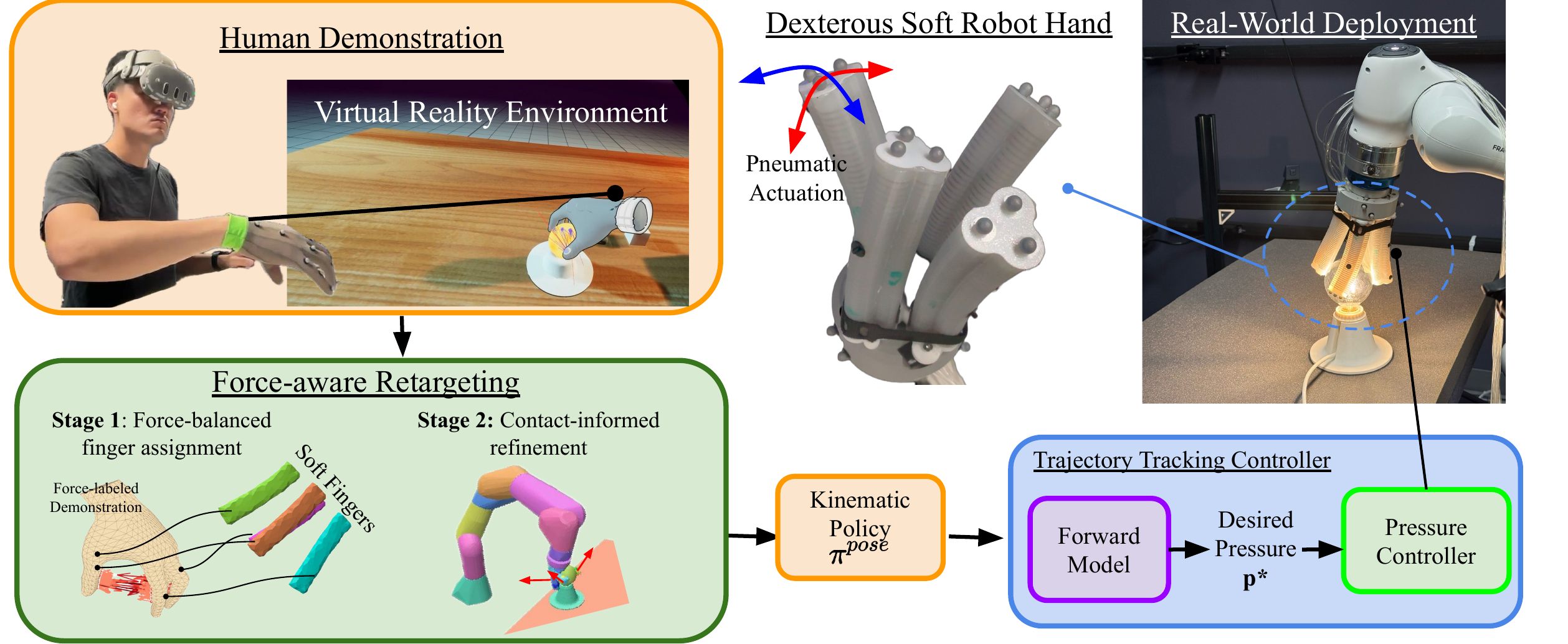
We introduce SoftAct, a framework for teaching soft robot hands to perform human-like manipulation skills by explicitly reasoning about contact forces. Leveraging immersive virtual reality, our system captures rich human demonstrations, including hand kinematics, object motion, dense contact patches, and detailed contact force information. Unlike conventional approaches that retarget human joint trajectories, SoftAct employs a two-stage, force-aware retargeting algorithm. The first stage attributes demonstrated contact forces to individual human fingers and allocates robot fingers proportionally, establishing a force-balanced mapping between human and robot hands. The second stage performs online retargeting by combining baseline end-effector pose tracking with geodesic-weighted contact refinements, using contact geometry and force magnitude to adjust robot fingertip targets in real time. This formulation enables soft robotic hands to reproduce the functional intent of human demonstrations while naturally accommodating extreme embodiment mismatch and nonlinear compliance. We evaluate SoftAct on a suite of contact-rich manipulation tasks using a custom non-anthropomorphic pneumatic soft robot hand. SoftAct's controller reduces fingertip trajectory tracking RMSE by up to 55% and reduces tracking variance by up to 69% compared to kinematic and learning-based baselines. At the policy level, SoftAct achieves consistently higher success in zero-shot real-world deployment and in simulation.

Overview

Method

SoftAct system overview: VR demonstration, force-aware retargeting, soft robot deployment

Data Collection in Virtual Reality

Demonstrations are captured using an OptiTrack motion capture system (10 cameras, 24 markers) mapped to a kinematic hand model inside an Unreal Engine VR environment. At every timestep we record the tuple (Bt, Vt, Ct) — hand body pose, object pose, and the full contact set. Each contact in Ct contains a surface location c ∈ ℝ³ and a force vector f ∈ ℝ³. Collecting in simulation yields precise, noise-free contact measurements that are difficult to obtain in the real world.

The goal is to learn a robot control policy π(at | ot) that achieves functionally equivalent object interactions, using the rich contact and force information captured during human demonstration.

Human demonstrations across the six manipulation tasks, captured in VR with contact force heatmaps overlaid on the hand.

Human demonstrations of the manipulation tasks performed in the VR environment.

Stage 1 Force-Balanced Finger Assignment

Contact information must propagate along the hand surface, not through free space — Euclidean distance would incorrectly couple physically unrelated regions. We measure surface distances using mesh geodesics and diffuse contact forces over the hand mesh with a geodesic heat kernel: each vertex accumulates a heat value weighted by nearby contact force magnitudes and geodesic proximity.

Heat values are summed within each skeleton finger region to estimate the total contact load per finger. Robot fingers are then allocated by solving a minimax assignment — distributing load as evenly as possible across the available robot fingers, allowing many-to-one mappings that remain fixed throughout execution.

Stage 2 Contact-Informed Refinement

During execution each soft finger tracks its assigned human fingertip while incorporating local contact geometry. Each demonstrated contact contributes a geodesic-weighted influence based on surface proximity and force magnitude. The fingertip target is then adjusted by the force-weighted mean displacement toward nearby contacts, clamped to a maximum step size, producing contact-informed trajectories used for imitation learning.
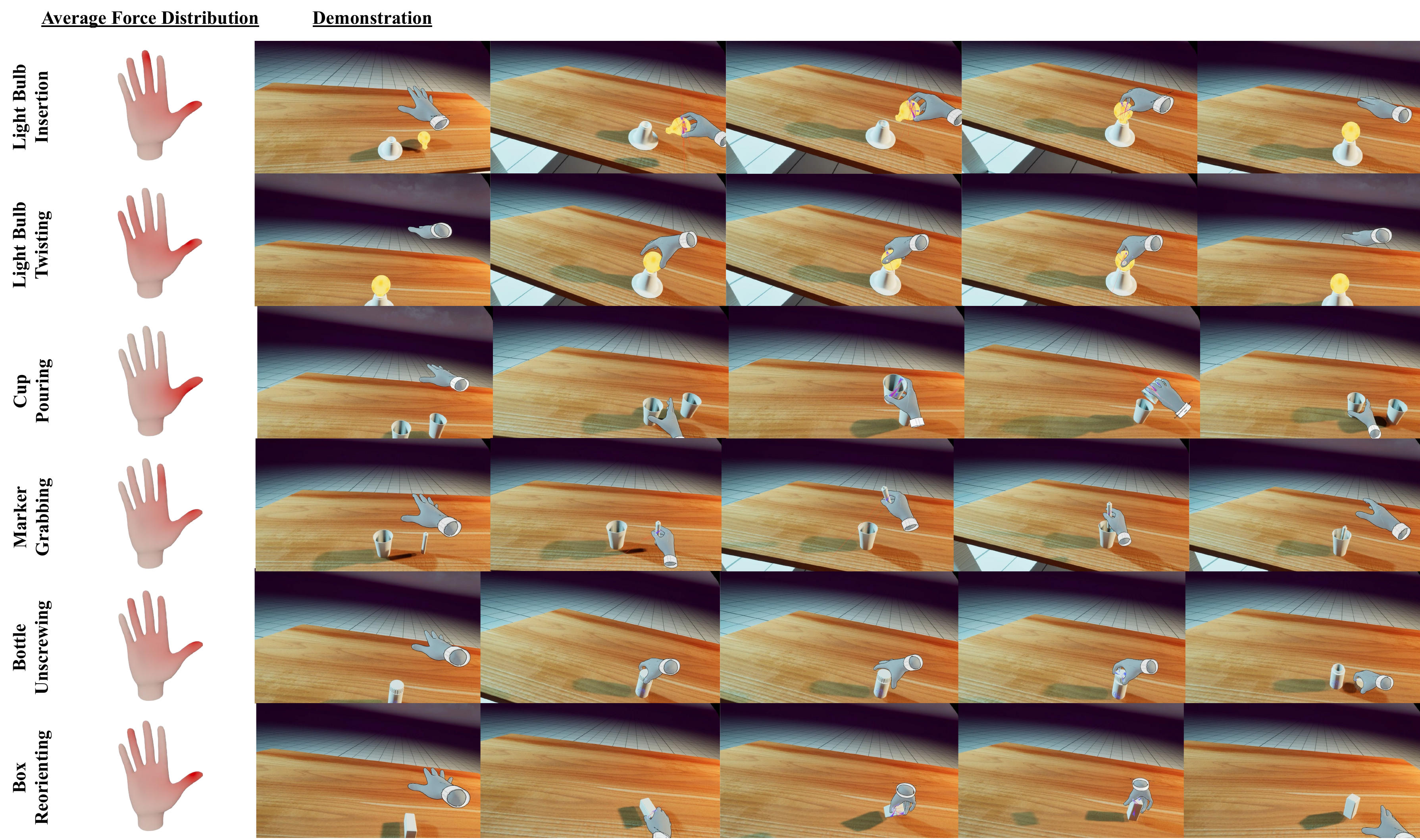
Figure 4: Average contact force distribution and demonstration frames for each task

VR Demo (Left) Average contact force distribution on the human hand for each task. Warmer colors indicate higher contact load. (Right) Representative demonstration frames from the VR environment.

Soft Robot Hand

We use a custom non-anthropomorphic pneumatic soft robot hand with four three-chambered fingers arranged in a square configuration. Each finger is fabricated from elastomer with embedded rigid rings, and bends via differential pressurization of its three chambers — producing planar constant-curvature deformation. The hand mounts on a 7-DoF robot arm and is driven by a pneumatic pressure controller.

Single Finger Module: elastomer body, rigid rings, and three-chamber pressurization.

Simulation model: virtual spine structure with torque-driven actuation used for policy training.

Low-Level Pressure Controller

Pressure–deformation relationships in soft fingers are highly nonlinear and vary across the workspace. We learn a per-finger forward kinematic MLP mapping chamber pressures to fingertip displacement, then invert it at runtime via gradient descent to find the pressures that achieve a desired tip position. Actuator limits are enforced with a sigmoid reparameterization, and each solve is warm-started from the previous solution. This yields significantly more accurate tracking than direct prediction baselines.
Retargeting Scene Visualization

Select a task and a retargeting stage to see the 3D scene at the key frame with maximum contact density. Drag to orbit · Scroll to zoom.

Select a task above to see the contact force analysis.

Demo Human Key Frame

Human hand point cloud at the timestep with peak contact density. Color encodes contact force magnitude from the geodesic heat kernel htv. Bright yellow markers show individual contact force locations and their magnitudes.

Stage 1 Finger Assignment

Dashed colored lines connect human fingertips to their assigned robot fingers. Each color group shows which human finger regions are covered by a single robot finger, based on the minimax load-balancing optimization.

Stage 2 Contact Refinement

Colored arrows show the geodesic-weighted adjustment δi applied to each robot fingertip. The arrow direction and magnitude reflect the contact-informed correction that aligns the robot's contact surface with the demonstrated contact geometry.

Full SoftAct Final Policy

The soft robot hand in its final retargeted configuration, ready for policy execution. The three-chambered soft fingers (shown with chamber color coding) are positioned to reproduce the functional intent of the human demonstration despite extreme morphological mismatch.

Retargeting stages. From recorded contact forces on the demonstrator hand (left), through kinematic retargeting with soft fingers, to the contact-informed SoftAct refinement and final real-robot execution (right).

Evaluation & Results

Low-Level Trajectory Tracking. SoftAct achieves the lowest RMSE (2.28 mm) across planar reference trajectories compared to Direct KNN, MLP, and Linear baselines.

Table II — Object Trajectory Tracking (Simulation)

Translational (m) and rotational (°) error vs. ground-truth demonstrations. Lower is better. Bold = best per task.

Task Method Pos. (m) Rot. (°)
Light Bulb Insertion
Kinematic1.52 ± 0.6111.8 ± 3.4
SoftAct-stage 2 only0.97 ± 0.4225.1 ± 7.9
SoftAct (Ours)0.48 ± 0.2112.4 ± 8.1
Light Bulb Twisting
Kinematic0.05 ± 0.0718.2 ± 6.5
SoftAct-stage 2 only0.07 ± 0.039.4 ± 3.4
SoftAct (Ours)0.02 ± 0.0052.9 ± 1.3
Cup Pouring
Kinematic1.29 ± 0.5012.5 ± 4.1
SoftAct-stage 2 only0.81 ± 0.356.4 ± 2.2
SoftAct (Ours)0.51 ± 0.213.5 ± 1.3
Marker Grasping
Kinematic0.97 ± 0.4114.3 ± 5.0
SoftAct-stage 2 only0.56 ± 0.257.3 ± 2.5
SoftAct (Ours)0.31 ± 0.133.9 ± 1.5
Bottle Unscrewing
Kinematic0.26 ± 0.1121.3 ± 7.2
SoftAct-stage 2 only0.11 ± 0.0511.1 ± 3.8
SoftAct (Ours)0.07 ± 0.126.7 ± 2.6
Box Reorienting
Kinematic1.34 ± 0.5417.6 ± 6.0
SoftAct-stage 2 only0.89 ± 0.379.0 ± 3.1
SoftAct (Ours)0.62 ± 0.265.1 ± 2.0
Real-world policy rollouts on the soft robot hand

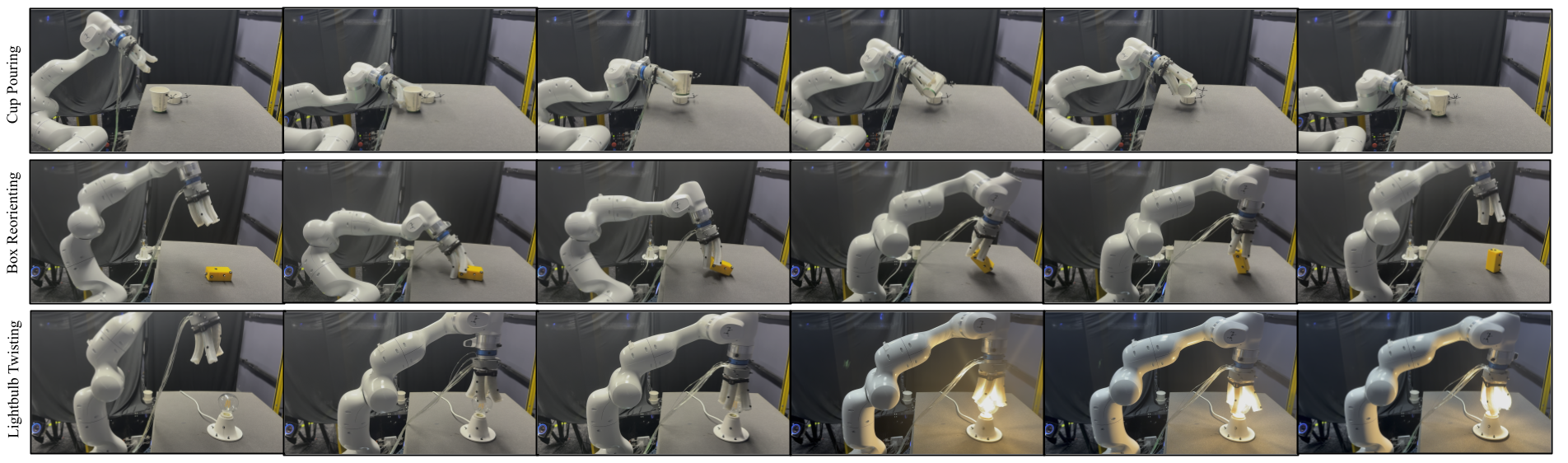
Real-world rollouts. SoftAct policy executing paper cup pouring, box reorientation, and light bulb screwing on the physical soft robot hand. Zero-shot transfer from simulation.

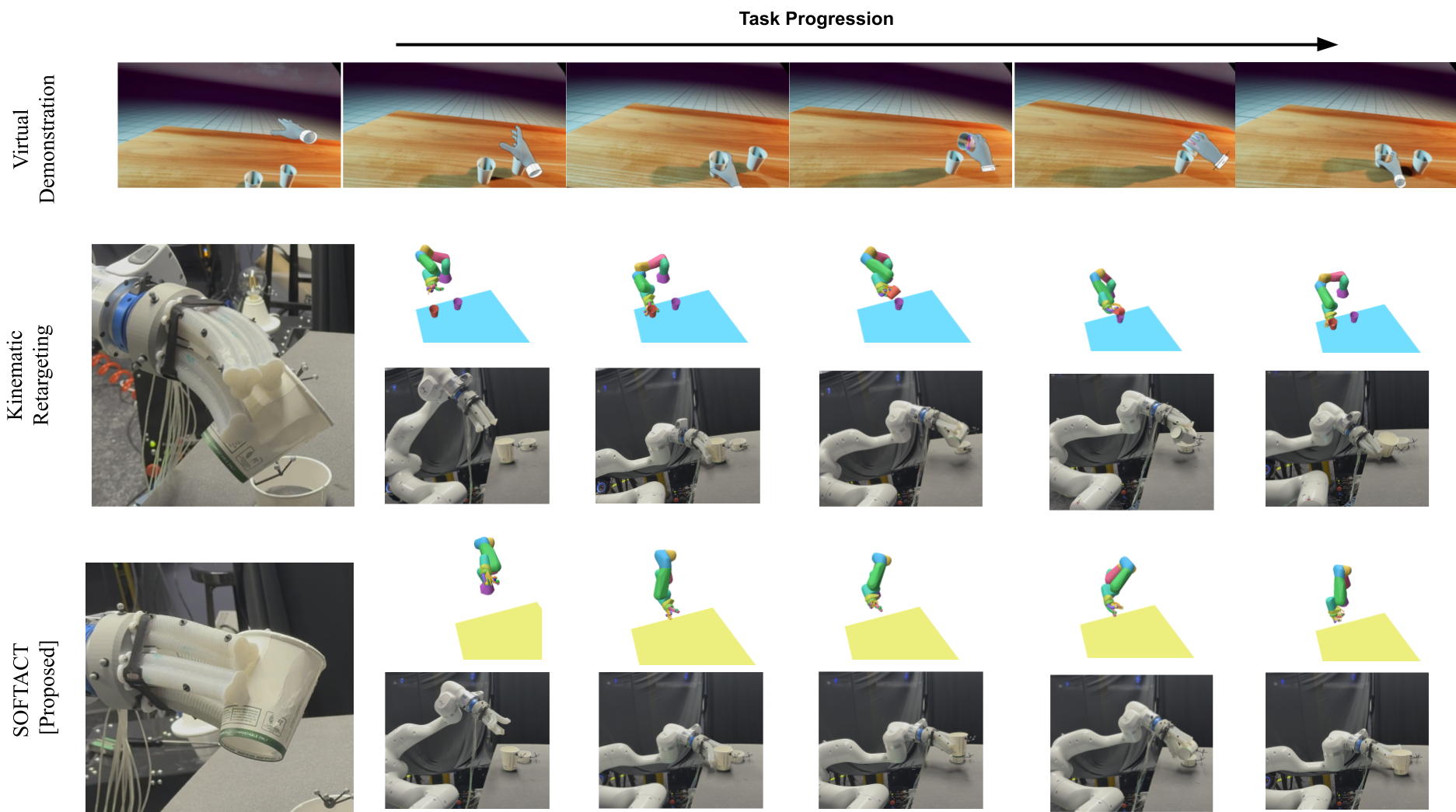
Qualitative comparison: VR demonstration vs Kinematic Retargeting vs SoftAct

Qualitative comparison. Task progression frames for (top) the virtual human demonstration, (middle) kinematic retargeting baseline, and (bottom) SoftAct. SoftAct achieves more natural contact configurations that better replicate the functional intent of the human demonstration.

Table III — Task Success Rates

30 rollouts (simulation) / 20 rollouts (real world) per method per task. Higher is better.

Task Domain SoftAct Kinematic Baseline
Paper Cup PouringSimulation90%40%
Light Bulb InsertionSimulation47%0%
Marker GraspingSimulation97%73%
Bottle UnscrewingSimulation80%47%
Box ReorientingSimulation90%30%
Light Bulb ScrewingSimulation100%77%
Paper Cup PouringReal World85%35%
Light Bulb ScrewingReal World95%30%
Box ReorientingReal World70%10%

Citation

@article{softact2026,
  title={Functional Force-Aware Retargeting from Virtual Human Demos to Soft Robot Policies},
  author={Yoo, Uksang and Zhu, Mengjia and Pezent, Evan and Preechayasomboon, Jom
          and Oh, Jean and Ichnowski, Jeffrey and Memar, Amir and Abbatematteo, Ben
          and Bharadhwaj, Homanga and Deshpande, Ashish and Prahlad, Harsha},
  year={2026},
  eprint={2604.01224},
  archivePrefix={arXiv},
}